Over 2 million UK over-50s experience loneliness, yet the solution is closer than most people realise. Friendship matching, once a niche service run by a handful of charities, is now widely available across the UK through both established organisations and newer digital platforms. Many over-60s simply don’t know it exists, or assume it’s not for them. This guide explains what friendship matching actually involves, how the process works step by step, what the evidence says about success rates, and how you can take your first practical step towards a genuine new friendship.
Table of Contents
- What is friendship matching and why does it matter?
- How does friendship matching work?
- How successful is friendship matching for over-60s?
- Manual vs algorithmic matching: Which is best?
- The truth most people miss about making new friends over 60
- Ready to start your own connection journey?
- Frequently asked questions
Key Takeaways
| Point | Details |
|---|---|
| Simple process, big impact | Friendship matching pairs over-60s with compatible peers to combat loneliness and improve wellbeing. |
| Manual beats apps for seniors | Evidence shows manual, interest-based matching often leads to higher engagement than complex algorithms. |
| Success takes persistence | Only about one in three matches leads to ongoing friendship, so trying again is normal and encouraged. |
| Openness is key | Making the first move and staying flexible is more important than finding a perfect match straight away. |
What is friendship matching and why does it matter?
At its simplest, friendship matching is a structured way of connecting people who might otherwise never meet. It’s not about romance or networking. It’s about finding someone who enjoys similar things, lives nearby, and is open to building a real friendship over time.
Friendship matching is a process used by befriending services and apps to pair individuals, particularly older adults over 60, with compatible volunteers or peers based on shared interests, hobbies, personality traits, location, and demographics, with the aim of fostering meaningful connections and combating loneliness.
This matters enormously for over-60s in the UK. Retirement, bereavement, health changes, and children moving away can quietly erode social networks that took decades to build. Many people in this situation don’t feel comfortable walking into a community centre alone or striking up conversations with strangers. Friendship matching removes that awkwardness by doing the introductory work for you.
The main factors considered when pairing people typically include:
- Shared hobbies and interests (gardening, reading, walking, crafts)
- Geographical proximity (to make in-person meetings practical)
- Personality and communication style (introvert or extrovert, chatty or reflective)
- Availability and preferred contact method (phone, online, or face to face)
- Life stage and background (retired, widowed, living alone)
The impact on wellbeing can be significant. Loneliness is linked to higher risks of depression, cognitive decline, and poor physical health. A matched friendship, even one that begins with a weekly phone call, can interrupt that cycle.
Platforms like Social Souls are making this kind of human connection more accessible for over-60s across the UK, offering a safe and easy-to-use space where people can connect based on genuine compatibility. Age UK befriending schemes have been doing this work for years through trained volunteers, and their model continues to reach thousands of isolated older adults annually.
How does friendship matching work?
The process is more straightforward than most people expect. Whether you’re joining a charity scheme or a digital platform, the core steps follow a similar pattern.
- Sign up and complete a profile. You share basic information about yourself, your interests, where you live, and what you’re looking for in a friendship.
- An assessment or questionnaire. Many schemes ask additional questions about your personality, lifestyle, and communication preferences to improve the quality of the match.
- Matching takes place. Either a coordinator reviews your profile manually, or a platform uses an algorithm to suggest compatible people.
- Introduction is made. You’re introduced to your match, often starting with a phone call, a message, or a guided first meeting.
- Ongoing support. Most established schemes check in with both parties to see how things are going and offer guidance if needed.
The table below compares the two main approaches used in the UK:
| Feature | Manual matching (charities) | Algorithmic matching (apps/platforms) |
|---|---|---|
| Speed | Slower, weeks to months | Faster, days to weeks |
| Personalisation | High, human judgement involved | Variable, depends on data quality |
| Scale | Smaller, local focus | Larger, national reach |
| Support offered | Ongoing coordinator support | Often self-directed |
| Best for | Those wanting guidance | Those comfortable online |
For UK seniors over 60, friendship matching primarily occurs via established charities using manual, interest-based pairing, though digital platforms are growing quickly in this space.
Pro Tip: Don’t feel locked in after your first match. Most good schemes build in a trial period precisely because not every pairing clicks straight away. If a match doesn’t feel right after a few conversations, it’s completely normal to ask for a rematch.
After a match is made, contact usually begins gently. A short phone call, a message exchange, or a walk in a local park. The goal isn’t instant best friendship. It’s a gradual, comfortable build. You can register for Social Souls today to begin that process in a verified, supportive environment.

How successful is friendship matching for over-60s?
It’s worth being honest here. Not every match becomes a lasting friendship, and that’s fine. Understanding the realistic picture helps you go in with the right expectations and stay motivated if the first attempt doesn’t work out.
Research from the B:friend scheme results, which analysed 805 pairings, found roughly a one-in-three success rate for forming ongoing friendships. That might sound modest, but consider what it means in practice. One in three people who try a structured scheme walk away with a genuine new friend. For someone who hasn’t made a new friend in years, that is transformative.
Factors that tend to predict a successful match include:
- Shared interests that translate into activities (not just passive hobbies like watching television)
- Similar communication preferences (both enjoying phone chats, or both preferring face-to-face meetings)
- Geographical closeness (making regular meetups realistic)
- Mutual openness (both parties being willing to invest time and effort)
- Similar life circumstances (both widowed, both retired, both living alone)
The signs that a match is likely to flourish are usually visible early. If you find yourself looking forward to your next call, if conversations feel easy rather than forced, and if you discover new things you have in common, those are strong indicators.
The stakes are high in the best possible way. Larger and mutual long-term friendships boost wellbeing more than family for isolated seniors, which means a single good friendship can genuinely change your quality of life. Reviewing friendship safety tips before you begin is a sensible step to ensure your experience stays positive from the start.
Manual vs algorithmic matching: Which is best?
This question comes up often, and the honest answer is: it depends on what you need.
Manual matching, used by most UK charities, relies on a trained coordinator reviewing profiles and using human judgement to identify compatibility. It’s slower but tends to produce thoughtful pairings. The coordinator can pick up on nuances that a data form might miss, such as tone of voice, specific life experiences, or subtle personality cues.
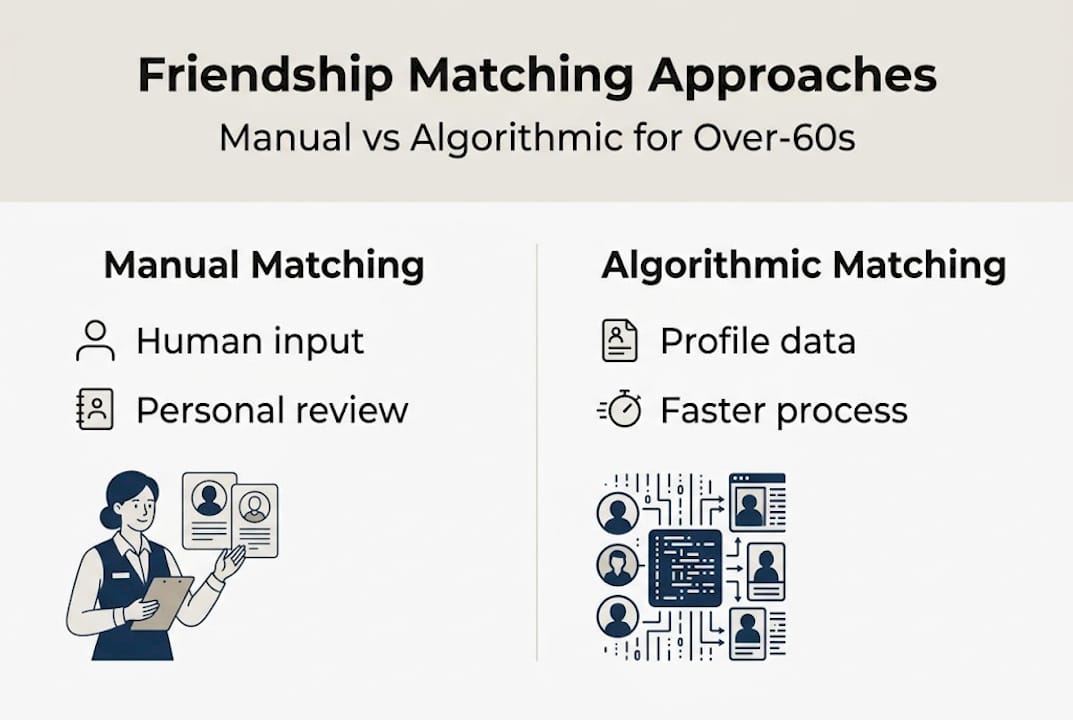
Algorithmic matching, used by apps and digital platforms, works at scale. It can process thousands of profiles quickly and suggest matches based on data points like location, age, and stated interests. The speed is appealing, but there’s a catch.
Algorithms in friend matching may underperform compared to random or proximity-based pairing, according to expert analysis. The reason is subtle but important. Friendship is not purely a product of shared data. It grows from chemistry, timing, and shared experience, none of which an algorithm can fully predict.
Here’s a quick breakdown of both approaches:
Manual matching
- Pros: Thoughtful, personalised, supported, better for those new to digital tools
- Cons: Slower, limited by coordinator availability, smaller pool of potential matches
Algorithmic matching
- Pros: Fast, wide reach, accessible at any time
- Cons: Can feel impersonal, may prioritise surface-level data over real compatibility
Pro Tip: Look for schemes that offer a hybrid approach, where technology helps with the initial search but a human coordinator or community team is still involved. This tends to combine the best of both worlds for over-60s.
The Social Souls accessibility statement reflects a genuine commitment to making digital connection easy for older adults, including adjustable text sizes and colour options that reduce the friction many over-60s feel when using online platforms for the first time.
The truth most people miss about making new friends over 60
Here’s something the guides and statistics rarely say plainly: the matching method matters far less than your willingness to show up.
We’ve seen people spend months researching the perfect scheme, comparing algorithms, reading reviews, and waiting for the ideal moment to join. Meanwhile, someone else signs up on a Tuesday afternoon with no particular expectations, gets matched within a fortnight, and is walking their new friend’s dog by the following month.
The biggest barrier to friendship over 60 is not technology, geography, or even loneliness itself. It’s the quiet fear that it’s too late, or that you’ve forgotten how to make friends. You haven’t. The skills are still there. They just need a nudge.
Expect a few misses. Expect the odd awkward phone call. That’s not failure; it’s just the process. The schemes that work best aren’t the ones with the cleverest algorithm. They’re the ones where people keep trying. Finding friends with Social Souls starts not with a perfect profile, but with the simple decision to begin.
Ready to start your own connection journey?
If this guide has given you a clearer picture of how friendship matching works, the next step is a practical one.
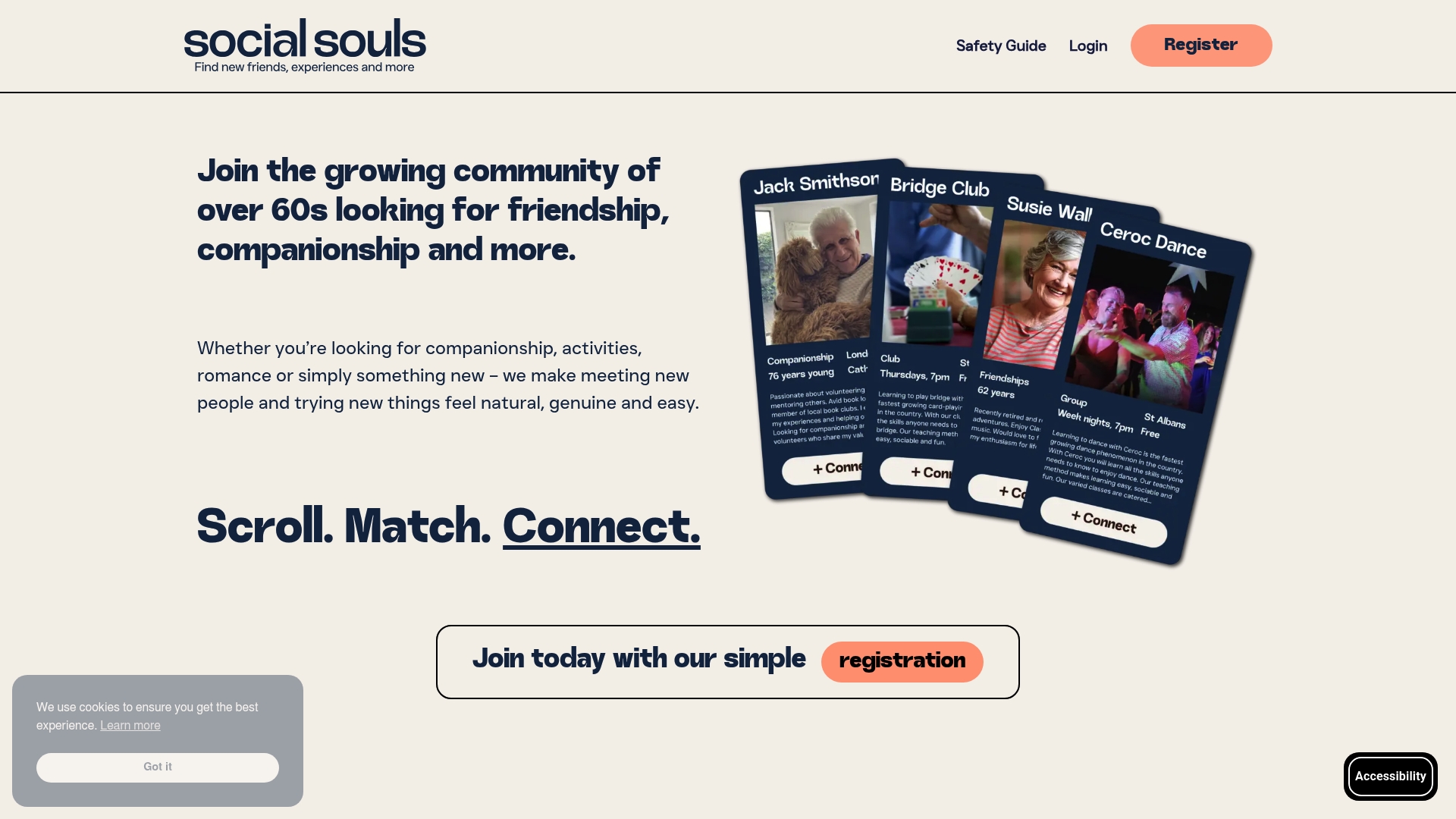
Social Souls is built specifically for over-60s in the UK who are ready to meet people, share experiences, and build genuine friendships in a safe, verified community. Founding members receive free lifetime membership, so joining now means you’re part of something from the very beginning. Whether you’re an individual looking for companionship or an organisation wanting to connect your members with a wider community, Social Souls offers the tools to make it happen. Explore safety and trust at Social Souls to see exactly how the platform keeps its members protected every step of the way.
Frequently asked questions
Is friendship matching safe for over-60s in the UK?
Most established schemes perform background checks on volunteers and offer ongoing coordinator support, making safety a genuine priority. Platforms like Social Souls also verify members and provide clear community guidelines to protect users.
How long does it take to be matched with a friend?
Matching times typically range from a few days on digital platforms to several weeks through charity-based schemes, depending on the availability of compatible matches in your area. UK charities using manual pairing may take longer but often produce more considered introductions.
Does friendship matching work better with apps or people?
Manual matching tends to produce higher satisfaction for over-60s because it accounts for nuance beyond shared data points. That said, algorithms may underperform in some cases, which is why hybrid schemes offering both technology and human oversight are often the most effective.
What if my first match isn’t successful?
It’s entirely normal for a first match not to work out, and most schemes build in trial periods or allow for rematching without any awkwardness. Persistence is the single most reliable predictor of eventually finding a lasting friendship through these programmes.